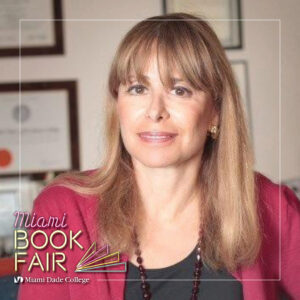
After serving as a judge for 20 years – most notably in the courts of Miami’s Dependency and Criminal Drug Court Divisions – Jeri Cohen retired from the bench in 2020. She has three adult children, a son and two daughters, and today shares her life with her partner, Richard Singer.
How did you first learn about Miami Book Fair?
I really can’t remember! But I do recall that when I first started going, I thought it was just a place to walk around and see book vendors. It was fun to browse and see people you knew that you ran into there. And then I realized that it was so much more – I could go and listen to authors.
What compelled you to become a Friend?
I think Miami Book Fair is one of the most incredible perks about living here and I want to support it. I look forward to it every year, I make sure I’ll be in town, I don’t plan vacations for that time of year. I feel good about wearing that (Friends) badge and I wish I could support the Fair at an even greater level. It’s just a tremendous gift to Miami-Dade County. It’s one of the best book festivals in the world.
Agreed! [both laugh]
It’s such a pleasure to see the authors you read, the historians, and the pundits come to life. I like the mix – writers, artists, poets, intellectuals. It’s nice to be in an environment where you can sit up close and spend time with these individuals and also ask them questions.
You just mentioned sitting up front – what are some other FOTF benefits you appreciate?
Learning about new authors, though that isn’t specifically a Friends benefit. At the last Fair, I was able to attend a panel of three Palestinian authors, all women. Susan Abulhawa, Etaf Rum, and Suad Amiry. Palestinians have such a difficult time getting their voices heard, across so many different forums, and this was a chance to listen to them talk about their books, their art, their lives, their history. And from that I had a recommendation to read Abulhawa’s Mornings in Jenin – which wasn’t even the book she was presenting that day – Minor Detail by Adania Shibli, and Stranger in My Own Land by Fida Jiryis, an autobiography about her family’s exile as refugees in Lebanon after the Nakba in 1948, and their eventual return to Palestine.
That’s a benefit – to be able to hear authors you may have difficulty becoming acquainted with. That’s huge.
Do you usually Book Fair solo or with friends?
My son, who lives here, goes with me sometimes and so does Richard. But a lot of the time I go on my own; I enjoy it. I see my friends there and other people I only see once a year at the Fair, and I listen to authors and chat and I love it.
What’s an MBF moment or experience that really stands out for you?
I saw Justice (Sonia) Sotomayor and that was a very, very moving session. She was talking about her children’s book, Just Ask, and she said she was going to get up and walk around the audience but everyone had to stay in their seats, except for the children. Watching her work the room with these children and answering their questions – she’s a very warm and loving person – that was really moving to me.
What’s the one book you think every kid (or teen) should have on their bookshelf?
Bryan Stevenson’s book, Just Mercy, should be on everyone’s shelf, especially young people. Between the World and Me by Ta-Nehisi Coates. And Night and Dawn by Elie Wiesel, so that they really get a feel for what hatred can do, what tolerance means, and how one person can change the world.
If you could sit down with any author, living or dead, who would it be and what would you ask them?
Do I have to pick one?
Not at all; if a few are coming to mind, tell me about all of them.
I’ve actually had long lunches with Ron Chernow, Roger Lowenstein, and Francis Fukuyama. I went to graduate school with Frank; he’s probably our greatest political philosopher. Roger wrote when Genius Failed and Ways and Means, which is a wonderful book. It talked about the economics of the Civil War, and how Lincoln used the war to centralize the government and go from gold to paper currency. It’s fascinating.
But if I could sit down with someone I don’t know, there would be three people on that list. The first is Bryan Stevenson; I think he’s a living hero. I just got back from his Legacy Museum and The National Memorial for Peace and Justice in Montgomery, Alabama. He has really focused the country’s attention on how massive the lynchings were, and he successfully litigated in the Supreme Court to prevent the death penalty and life without parole for juvenile offenders – he’s one man who has done so much to change the way that the larger community views race.
Second would be Ta-Nehisi Coates. I think he’s one of the best individuals today writing on race, society, and reparations. He’s such an interesting, intellectual person. He understands how race has infused so many aspects of our society, what it means for African American parents to raise Black children in this country, and he really seems – and I’m basing this on an article of his that I read, I think in The Atlantic or The New Yorker – he really seems to understand what the backlash was after Obama, what happened in the country that enabled Trump to be elected.
And then finally, I’d really like to meet Doris Kearns Goodwin. I love her books, I love seeing her on television; she’s a very relatable historian. I think she’d be a fascinating person to sit down with and discuss what’s going on today, especially in light of her book Leadership in Turbulent Times.
Interview by Elisa Chemayne Agostinho; responses have been edited for space and clarity.