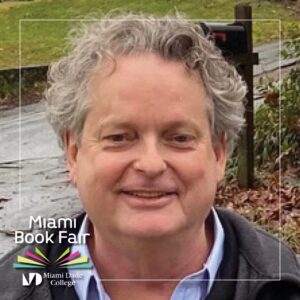
Terry Murphy came to Miami in 1982 – a move he made to run a political campaign for his brother, who was a state representative – and returned for good the following year after he graduated from college. He and his wife, Maribel Balbin, whom he met when they were both working at the county commission, have been Friends of the Fair for years. “We got married to have grandchildren,” he quips, and the couple now have four.
Do you remember how you first heard about the Fair?
I learned about it through my work for the commission. From early on there was support for the Fair from the county through the Cultural Affairs grants council and there were a lot of presentations about it before commission committees going on, because it was a growing event. So I knew about it then and started going regularly in the ’90s. Then when Maribel and I became a thing, I found out she’d actually been on staff at the Fair for a couple of years, from 1991 to 1993, I think.
Cool!
She’s always been a big fan of the Fair, and she was the one who introduced me to the idea of joining the Friends. Before that I sort of milled around and enjoyed the whole feel of the place without any kind of plan.
You’ve been a Friend for a long time – what are some of your favorite membership benefits?
There’s a couple of obvious benefits, including not having to wait in line to get in. You just wave your little lanyard with your badge and walk right in. [laughs] And if you’re registered for any author events, having that dedicated line for Friends that allows you to enter and get right to your seats is a nice perk as well. But the fun part is the lanyard and badge that says you’re a Friend of the Fair, and knowing that you’re supporting it. Sometimes our schedules are so hectic that we can’t attend – though that’s rare – but we still buy memberships every year. It’s our way of supporting what we think is a great event for Miami.
Book Fair started in 1984, when downtown was a very different place. What has it brought to Miami?
Book Fair is a critical piece of the puzzle that is Miami. We’re not just the cruise capital of the world or the only tropical metropolis in the United States. Having the Fair here puts us on the main stage of the literary world – and that’s an important signal that we’re not only a multilingual community for business and trade, we’re a community of people who are creative and thoughtful. I think that often gets overlooked because we’re a tourist destination.
What’s an MBF moment or experience that continues to resonate with you?
It would have to be hearing and meeting Pat Conroy. His books are so good; I’ve been in awe of him forever. I used to read him to my son when he was in the womb, and I think he recognized my voice in the hospital after he was born because of that. [laughs]
Getting to meet Conroy was interesting because my brother-in-law was at the Citadel at the same time he was, and when I met him I asked if he remembered him – and he did! He asked after him and the family and sent his regards. It was wonderful to have that moment with him.
Patti Smith, too. I’ve always associated her with her music and her place on the punk rock scene, but hearing her speak about the diligence that’s required to be a creative person was eye-opening. If you say you’re a writer, she said, then go write; write every day. It was so exciting to hear her talk about the discipline needed to create, and realizing that she’s very much a disciplined, studious, and focused person. I loved hearing that. I was thinking of writing a book myself, and that really inspired me.
Did you ever start?
I’m actually trying to get to it every day, just to get it all out. Then I’ll see if I can present it in a way that makes some kind of sense. [laughs]
I did a major bike ride last year after I retired, a 2,000-mile ride that took me from northwest Iowa where my parents are buried all the way across the Midwest – Iowa, Illinois, Indiana, Ohio – then into Pennsylvania, New York, Ontario, Montreal, and Quebec.
Wow! How long did that take you – and did you do it with a group?
It took me about two months; I was on my own. What I was doing was tracing all the places where my family had lived and settled upon coming to America from Ireland. I did that in Ireland last March – all my siblings and Maribel and I went and traveled to all the little places where my family originated. So I saw all the places they lived there and the bike ride was about where they landed here. Now I’m working on a sort of memoir/family history about those experiences.
That’s beautiful – I’d read that book.
One of the best things that happened on the ride was that I found the location of my great-grandfather Brown’s original homestead farm, so I rode by to just see the land. But when I got there there was this big brick house on the property, which was clearly still an active farm, and a sign that said, “Welcome to the Brown Farm – Established 1891.” So I went up to the house and knocked on the door, and this guy came out and said, “How can I help you? I saw you riding your bike down the gravel road – that was me in the pickup truck that passed you.” And I said, “I think I’m your cousin.” [laughs] And it turns out our grandfathers were brothers. He invited me in, we had some lunch, and we just hung out and talked for a really long time. It was great.
Tell me about the last good book you read.
How the Word Is Passed, by Clint Smith. It’s like a travelogue of American slave history; he tells the story through visits to different places, from New Orleans and Angola prison in Louisiana to Monticello in Virginia. It’s such an artfully well-written book – it’s researched but it also includes his interviews with the people he met and spoke to, and his observations. I really enjoyed reading it now, when there’s such a concerted effort to wipe out and rewrite American history, leaving out the essential story of slavery. It’s an important book.
What three authors, living or dead, would you pick to be in your fantasy book club?
Doris Kearns Goodwin, Pat Conroy, and Barack Obama. Spending time with any one of those three people would be a thrill.
Interview by Elisa Chemayne Agostinho; responses have been edited for space and clarity.